
Breton’s heritage in the work of Matej Gábriš
There are only few figures in the history of modern culture who have so radically transformed the perception of reality as André Breton did. In 1924, he published the Surrealist Manifesto (Manifeste du surréalisme), heralding a new chapter in art and culture. He himself was marked by the traumatic experience of World War I and sought to find the key to understanding the human mind in the theories of Sigmund Freud. He was fascinated by psychoanalysis and explored the subconscious. This became for him a vast reservoir of unbridled creative imagination. Breton attempted to merge two seemingly contradictory states—dream and waking reality. He called this new “state” of a higher, absolute reality “surreality.” He rejected pure rationalism as well as “bourgeois” logic. Breton understood surrealism as “pure psychic automatism,” a process free from any aesthetic or moral censorship [1].
How and why did this radical intellectual legacy find expression in the work of the Slovak visual artist and designer Matej Gábriš? The history of fine art is not entirely Matej’s domain, but since it is a common theme we encounter almost daily, it did not escape his—or our—notice that as early as 2024, several museums around the world commemorated the centennial of the publication of the aforementioned Surrealist Manifesto [2, 3], and that 2026 marks the anniversary of Breton’s birth (he was born in 1896). An even more important connection is Matej Gábriš’s sincere interest in the work of Czech Surrealists Jindřich Štýrsky and Toyen. And that brings us one step closer to André Breton. Because without him, there likely would have been no Štýrsky or Toyen. More precisely—their fascinating surrealist works would never have been created.
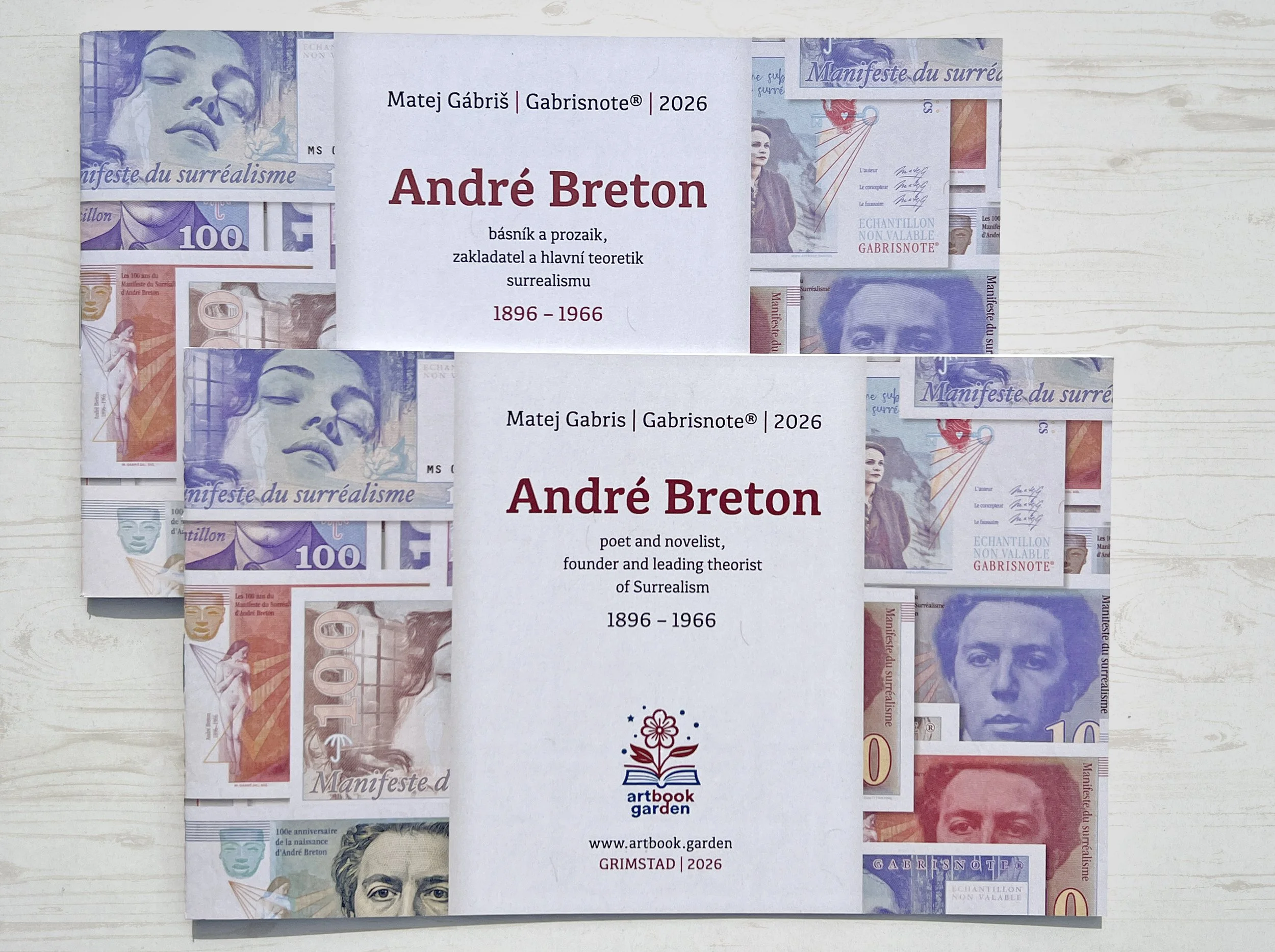
Two language versions of a collector's folder featuring five variants of Gabrisnote®. Source: ArtBook Garden’s Archive
If I were to write a post about all the places where we can still find interesting visual tributes to Surrealism today—or direct references to A. Breton’s work—the post would likely stretch to the length of at least a master’s thesis. On our website, I’d like to write more this time about what lies behind this work by M. Gábriš.
The Gabrisnote® featuring André Breton in three different color variations is not just a standard numismatic dedication; it is a playful tribute with multiple layers.
The chosen medium of a fictional banknote is, in itself, a game. On the surface, it looks like a “banknote” created according to strict rules and showcasing technical precision. The obverse side of this print shows us a masterful, technically flawless portrait of the young André Breton—everything looks real, except that this currency is “non-currency”—“Art only,” a work of art, a collector’s item. What is real and what is actually surreal? What is valid and what is not? For the Surrealists, the surreal held a higher value—the artistic one. Postwar reality was rough and heavy; the surreal world offered a new kind of value. That is precisely why the conceptual wit of this small work I am writing about today (the Gabrisnote® series: “Homage to Breton”) is revealed to the collector only when we apply a different “reality” to it—not a dreamlike one, but in this case, a different physical principle: ultraviolet light. Matej Gábriš has created a parallel reality within the work, in which he has hidden what is invisible in ordinary daylight. Certain parts and elements only come to the surface when illuminated by a UV light.
In this hidden, luminescent layer, a phosphorescent surrealism emerges. A glowing, linear drawing of Nadja appears, as if created in a single, uninterrupted, automatic stroke. Nadja was the central character in Breton’s famous 1928 novel of the same name. She represented the author’s obsession, teetering on the edge between dream and waking reality. This is also why Gábriš chose to conceal her within another, phosphorescent layer of his banknote. In addition to Nadja, we also see a phosphorescent detail of open eyes and sensually floating lips, referencing the dreamlike compositions of Man Ray or Salvador Dalí; the silhouette of a man in a stiff hat, which is an unmistakable reference to René Magritte; and finally, the symbol of an umbrella, reminiscent of Lautréamont’s key metaphor about the chance encounter between a sewing machine and an umbrella on an autopsy table. This visual tension between what we consciously see (the precise line of the stamp) and what remains hidden and appears only under specific conditions (an unbridled imagination full of symbols) also makes Gabrisnote® with Breton something of a manifesto in miniature.
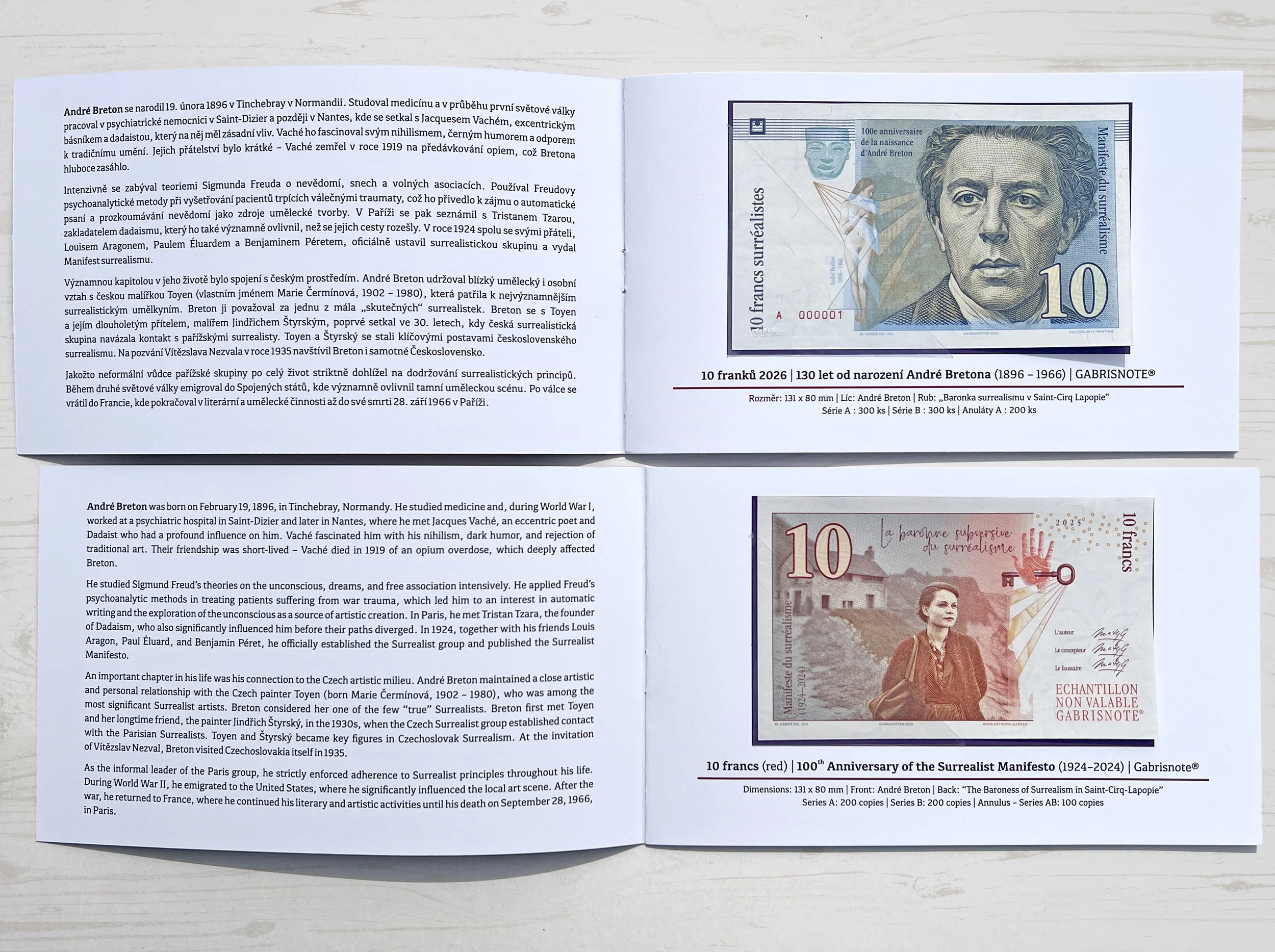
Two language versions of a collector's folder. Source: ArtBook Garden’s Archive
One more “art-historical” note to conclude: when Breton visited Prague in the spring of 1935 at the invitation of Vítězslav Nezval, he was so enchanted by the city’s mysterious atmosphere that he called it “the magical capital of old Europe.” His close personal and artistic friendships with local artists—especially Jindřich Štýrsky and the painter Toyen, whom he considered one of the few truly authentic representatives of the movement—made Czechoslovakia the official non-Parisian center of Surrealism. And we art historians—and, in my opinion, visual artists as well—are immensely pleased by this—because we have this legacy here, and it has influenced us since our youth and continues to influence us today. Even if we don’t always realize it.
Isn’t that right, André?
Bibliography:
[1] WALTERS, Gordon, 2022. Manifesto of Surrealism by André Breton. Online. In: EBSCO Advantage - Research starterrs. Birmingham: EBSCO Information Services. Available at: https://www.ebsco.com/research-starters/literature-and-writing/manifesto-surrealism-andre-breton#full-article. [accessed 2026-06-22].
[2] VOORHIES, James, 2004. Surrealism. Online. In: Heilbrunn Timeline of Art History. New York: The Metropolitan Museum of Art. Available at: https://www.metmuseum.org/essays/surrealism. [accessed 2026-06-22].
[3] Exhibition Surréalisme / Surrealism, 2024. Online. In: Centre Pompidou. Paris. Available at: https://www.centrepompidou.fr/en/program/calendar/event/gGUudFS. [accessed 2026-06-22].